How to play
Everything the game does, and the clock it lives by. Five minutes here and you know more than most gaffers.
How time works here
The world runs ONE ROUND PER REAL DAY, resolved overnight at 3am your league's local time. A season is 38 rounds - about six real weeks - and everything else keeps that clock.
A "week" in the game (injuries, wages, development) passes every real day. "Fit in 5 weeks" means fit in five real days.
Your own fixtures never resolve without you - they wait, as games in hand, until you play them or the season-end sweep settles what's left.
Miss a day? Nothing punishes you. The world moves on and your club is exactly where you left it.
Welcome, gaffer
You manage a football club. Set your team up, play matches, and shout from the touchline to change how your side plays. Your club lives in the cloud - sign in on any device and it's there.
Every club starts with the same money and the same income: no rich clubs, no bought titles, nothing to buy with real money. Ever.
A practice game, right now
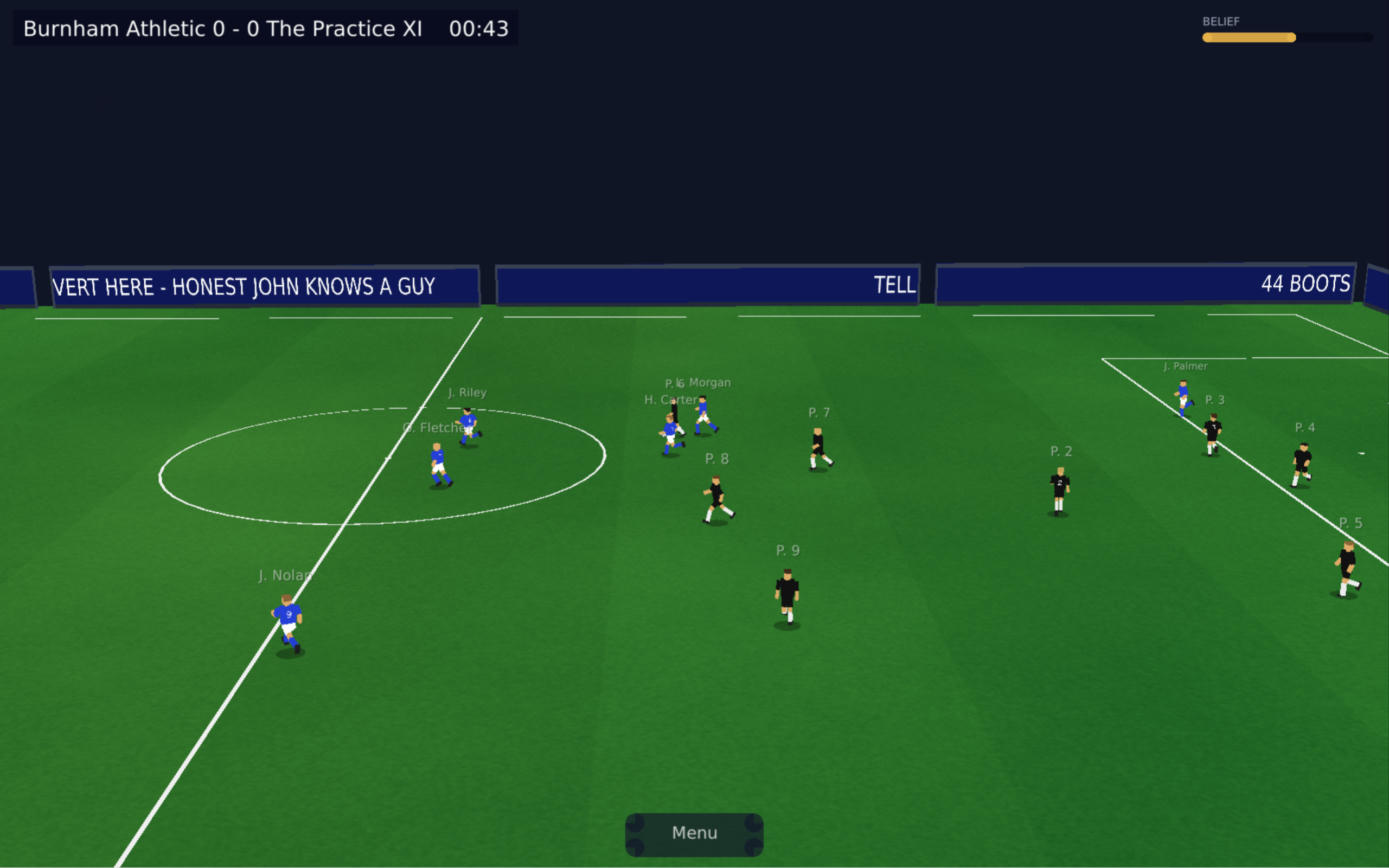
Ten minutes spare and you just want to watch your team play? Open the PLAYER LOUNGE and hit PRACTICE GAME at the top. You choose how good the opposition is - anything from 1 to 100 - and you get a made-up side at exactly that level, in black, called Player 1 to Player 16.
Every one of them carries that same number in EVERY attribute, and that is what makes it worth doing: nothing else is varying, so whatever happens out there is down to your side and your setup. Try a 20 to watch your shape work. Try a 90 to find out where it breaks.
It uses your real squad and your real team setup, nothing is at stake - no injuries, no morale, no record - and it works with no connection at all, because the opposition is built on your own device.
The office
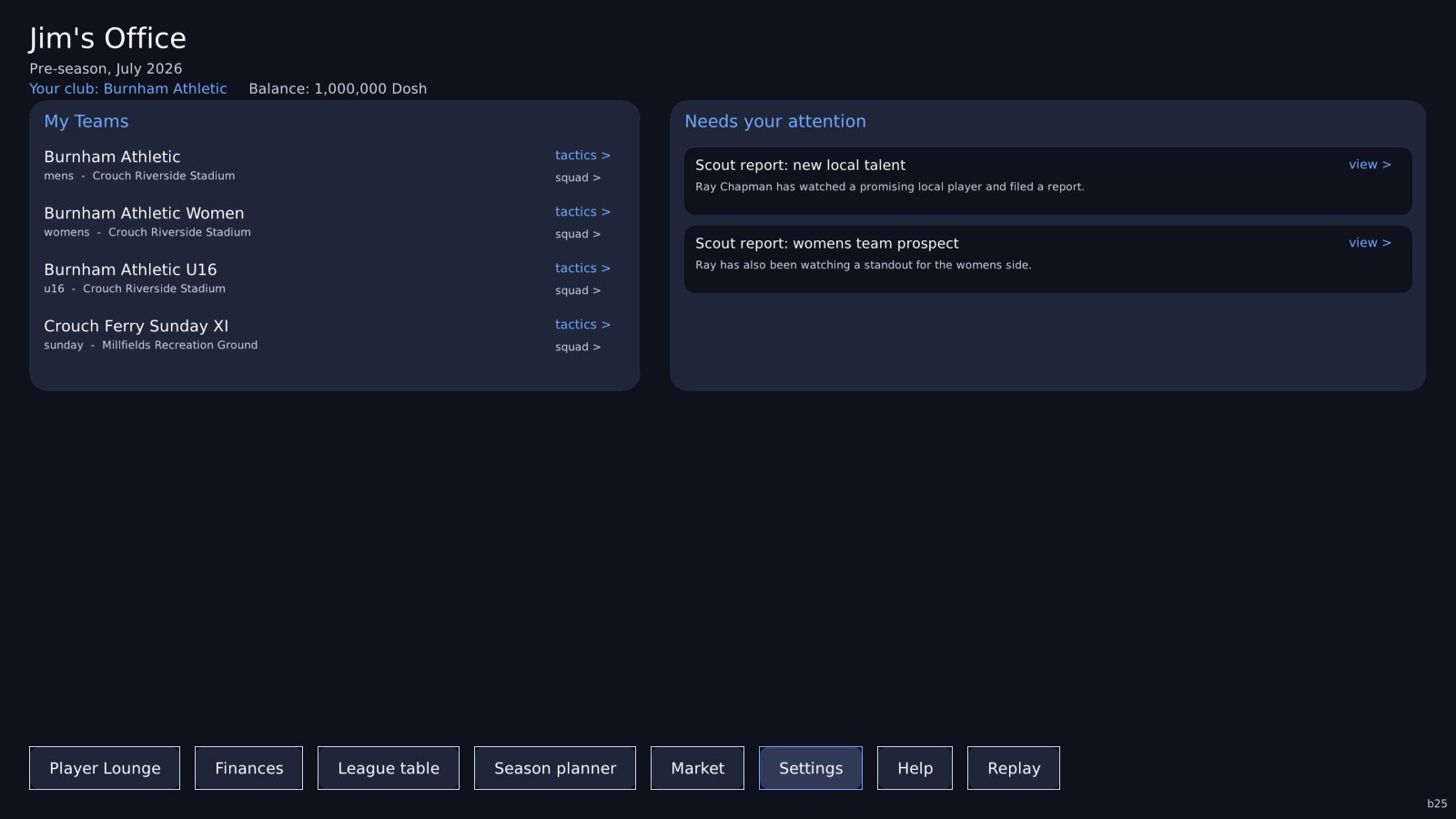
Home base. Your teams on the left, everything needing your attention on the right - injuries, results, transfer offers, a league match ready to play. The bottom bar reaches every part of the game: the Player Lounge, the League table, Honest John's Market, the Scout's desk, the Season planner, Finances, Settings, Help and the Replay of your last match.
FOUR SIDES, TWO OF THEM YOURS TO RUN. Every club fields a first team, a women's team, an U16 side and a Sunday XI, and pays all four - wages, kit, the lot. You can manage the FIRST TEAM and the WOMEN - the switch is in your office, on the website, and it costs nothing to change your mind. The U16s and the Sunday XI are where cheap players come from, not competitions to run - the club plays those itself and your scout brings you what they find. And neither of the two you CAN run is compulsory: say the word and your assistant takes one, or both.
Four of those - Market, Scout, Season planner and Finances - open 44boots.com rather than a screen in the game, and so do Set pieces and Training from the cards in the office. That is deliberate: they are long sortable tables and long reports, and a browser has always handled those better than a hand-built list on a phone. You are not asked to sign in again - the game hands the browser a one-use pass that lasts a minute, so you land already logged in.
Watching a match
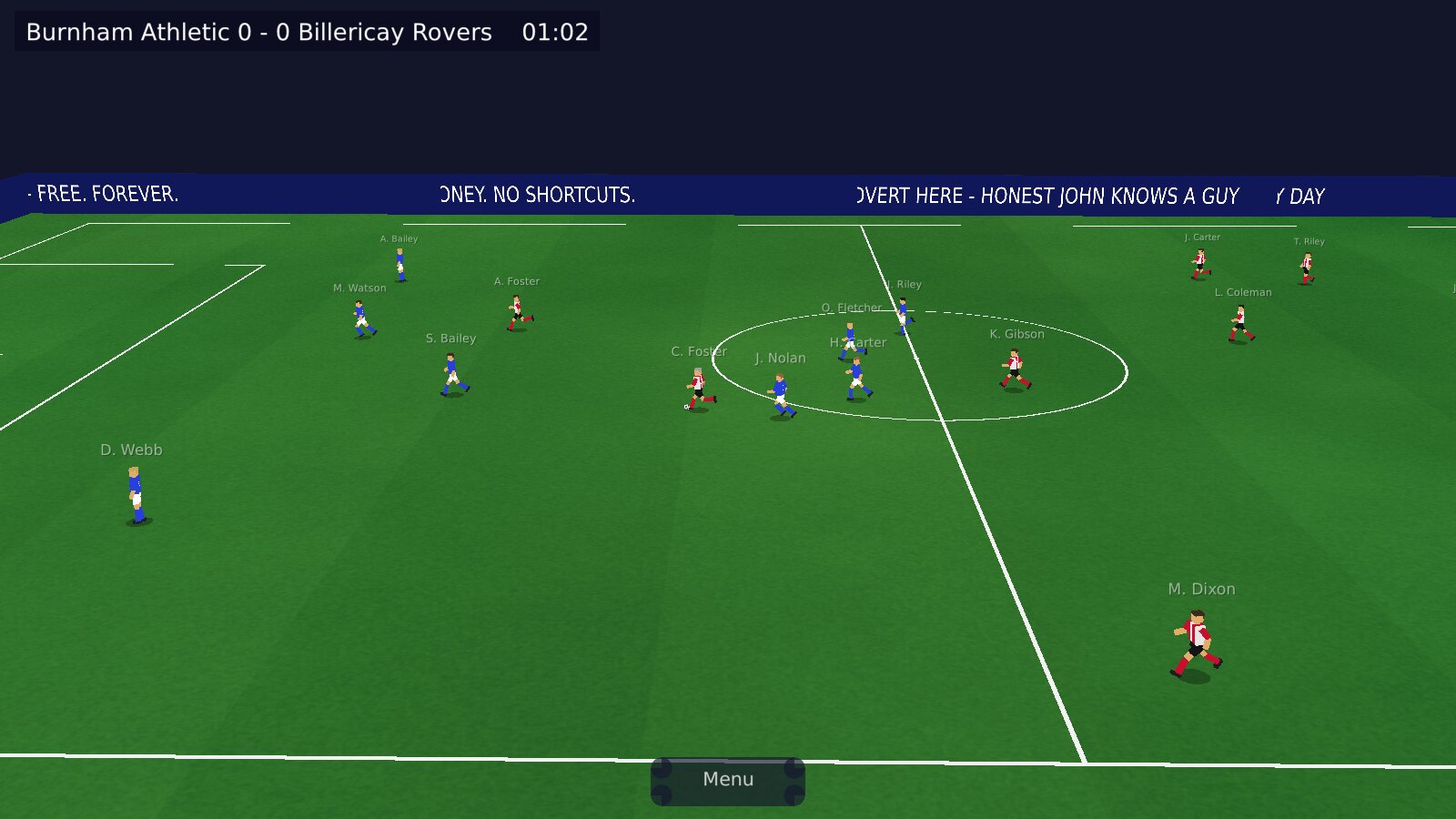
Matches play out live in 3D. The camera follows the ball; players show their name above and shirt number on their back. GOAL, FOUL and INJURY flash up as they happen.
Tap MENU (bottom centre) any time - the match plays on underneath. From it: SHOUT to change how your team plays, SUBSTITUTION, ZOOM, and EXIT.
The real rules apply: five subs per match across at most three stoppages, half-time free. Leaving a match early is recorded as a 1-0 defeat - only quit if you mean it.
Shouts from the touchline
Tactical stances persist until you change them: Mentality, Pressing, Tempo, Width, Directness, plus Overlap, Tighter Marking and Stay Back.
Motivational shouts move your team's BELIEF - Encourage and Praise lift it safely; Demand More! fires up strong characters but can rattle fragile ones; Calm Down cools rash tackling; Focus sharpens finishing for a spell. How well a shout lands depends on each player's character.
Rally calls are short bursts with a countdown: Push Up!, Get Stuck In!, Waste Time!
Every shout answers you. A strip appears under the scoreline naming what you just did and what it actually changes. Top right is the BELIEF bar - your team's live confidence, red when heads have gone down, green when they are flying. Encourage and Praise lift it, conceding drops it, scoring lifts it sharply, and it drifts back to normal by itself. Belief feeds how bravely players commit and how cleanly they execute.
Timed calls sit under the bar with the seconds left on them: Push Up, Get Stuck In and Waste Time run 75 seconds, Focus and Calm Down 90. When the chip goes, the effect has gone with it.
Setting up your team
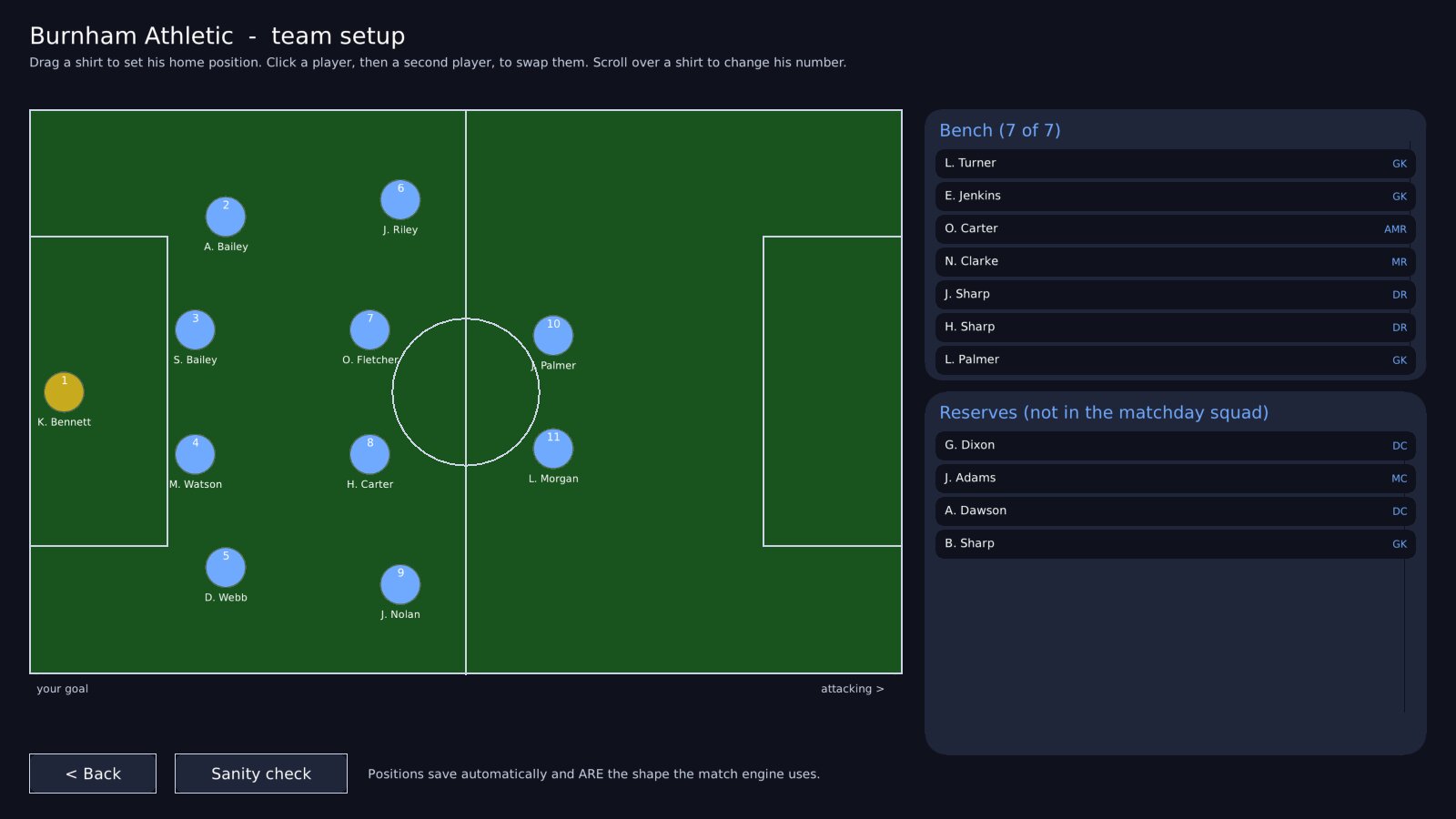
TEAM SETUP is your tactics board: drag shirts to set each player's home position, click two players to swap them, pick the bench and leave the rest in reserve. Shirt numbers are yours to assign.
The SANITY CHECK points out anything daft - keepers up front, injured players in the XI, a better player idling in reserve - without changing anything. Injured players show in red and are automatically replaced on match day if you leave them in.
The league
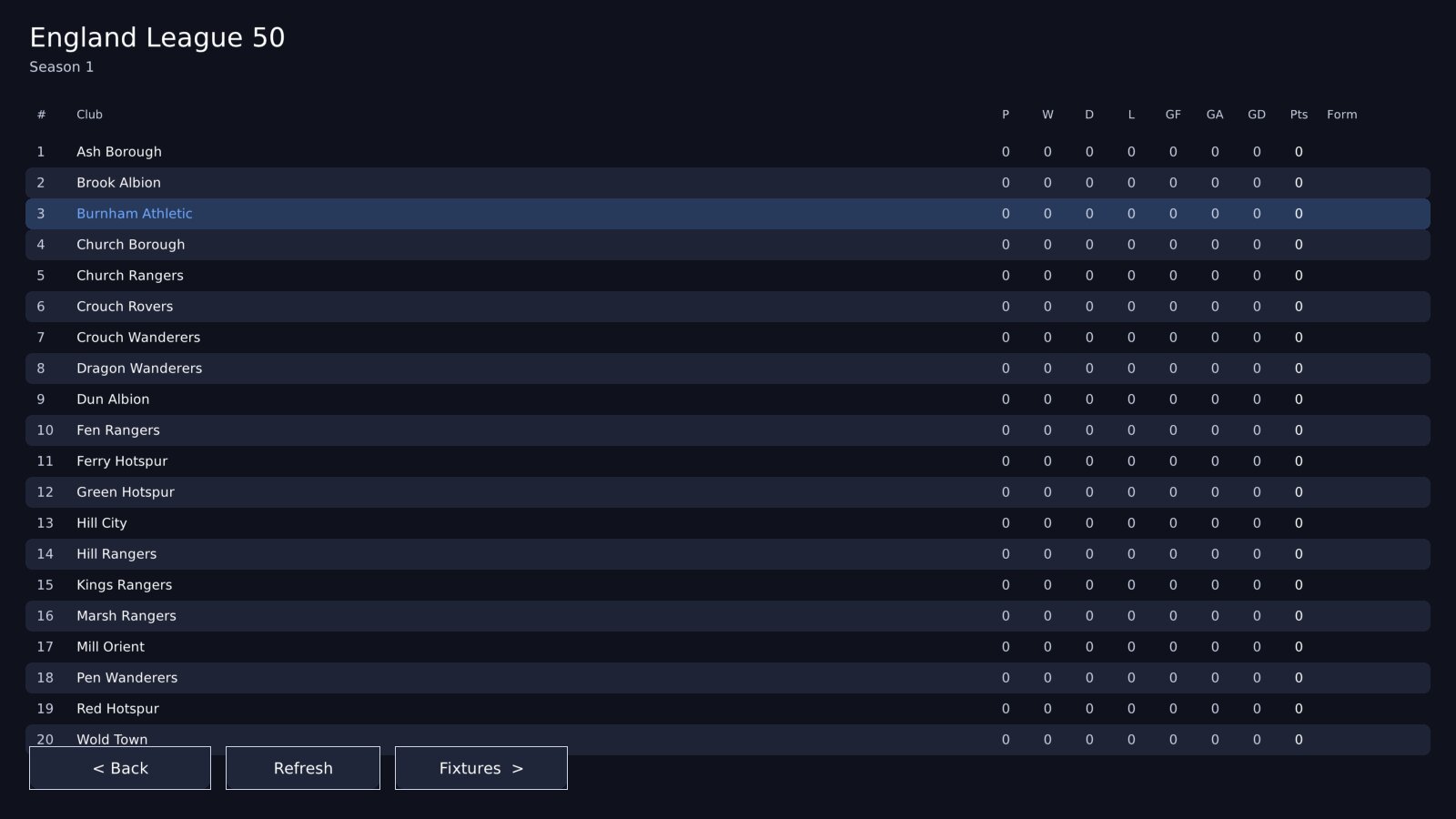
Take over a struggling club and it becomes YOURS, renamed to the team you registered. One round resolves per day; YOUR fixtures wait for you. When the world reaches one, a LEAGUE MATCH READY card appears in the office - play it live with your real squad. The result counts, the table moves.
Everyone here is a professional
There is no quality gap between divisions. A squad in League 2 and a squad in the newest division at the bottom are both full of professionals; the difference between them is how well they are MANAGED, not the raw material they were handed.
So promotion doesn't buy you better players - it puts you among better managers. Individual players still vary hugely, and a rare gem can appear at any club in any division, which is exactly what makes your scout and Honest John worth their money.
Amateurs sit below the professional standard, but never as far as you'd think. A Sunday player trains twice a week and runs all Sunday morning; what separates them from a pro is touch and judgement, not a pulse - and amateur sides give professional ones a fright often enough. Closing that gap is what the pathway is for.
Reading a player
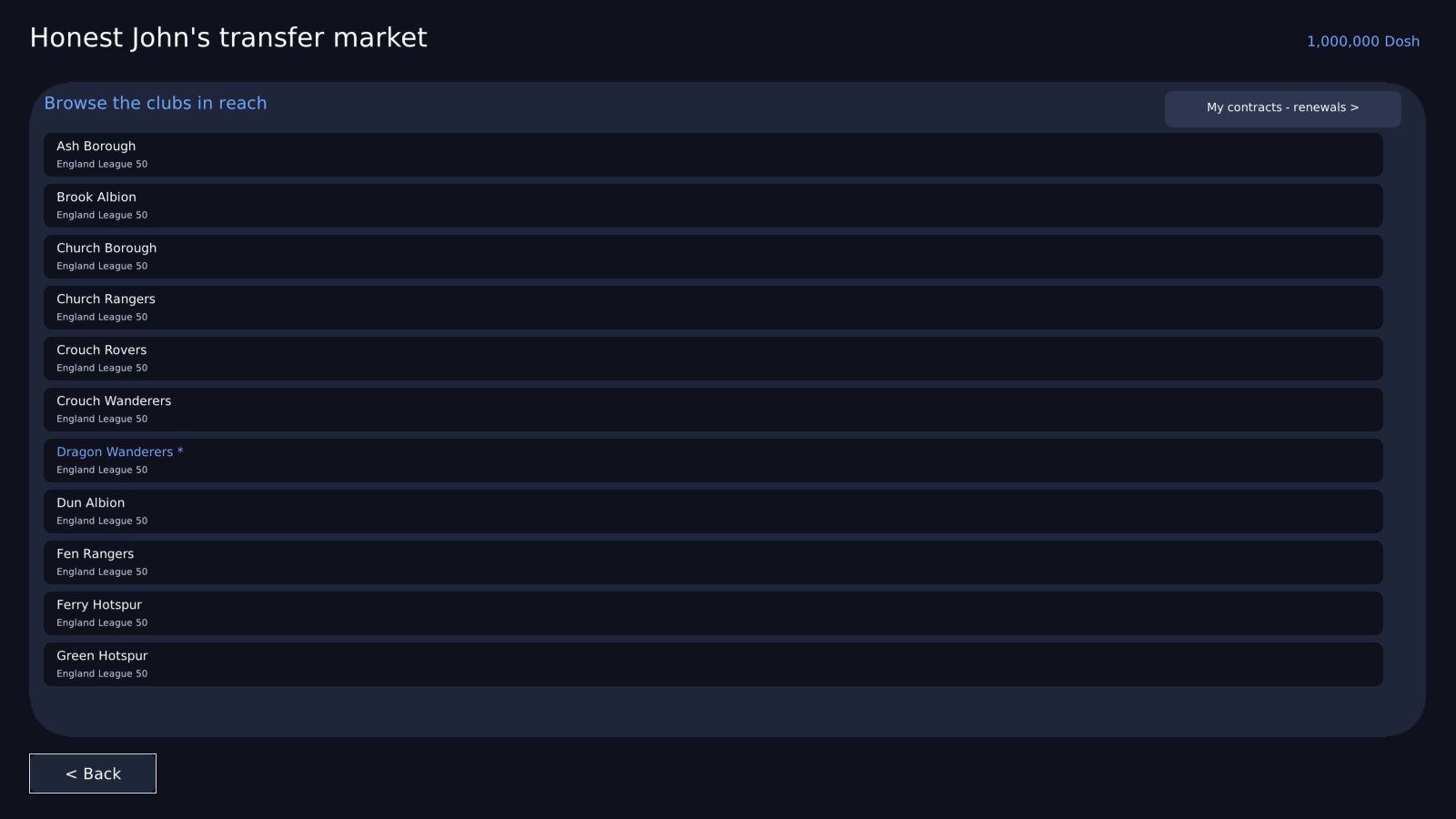
Attributes run 1 to 100. Above 85 is exceptional even among professionals; 65 to 84 is a genuine strength; 45 to 64 is the solid professional middle; 30 to 44 is a pro's weak area - they are still a trained athlete. The Sunday lads live around 30 to 45: keen, fit, short on touch. Academy kids read RAW with big ceilings - what a kid is at fourteen is nothing like what they might become.
Character attributes - Professionalism, Ambition, Loyalty, Temperament, Dirtiness - are NOT quality. They describe who a player is, and they matter as much as their feet: they decide how they answer a shout, whether their head is turned by a rival club, how often the referee books them, and what they get up to on their day off.
YOUR OWN players you see exactly - you train with them every day. Rival FIRST TEAMS and WOMEN'S sides are exact too: professional football keeps no secrets, everybody watches everybody play. Rival U16 and Sunday players arrive as your SCOUT'S RANGES - nobody films those games, and a better scout guesses tighter.
Every player is a PAGE: attributes, medical record, press cuttings from the Gazette, and a career line recorded nightly. Click any name, anywhere.
Money: the rules
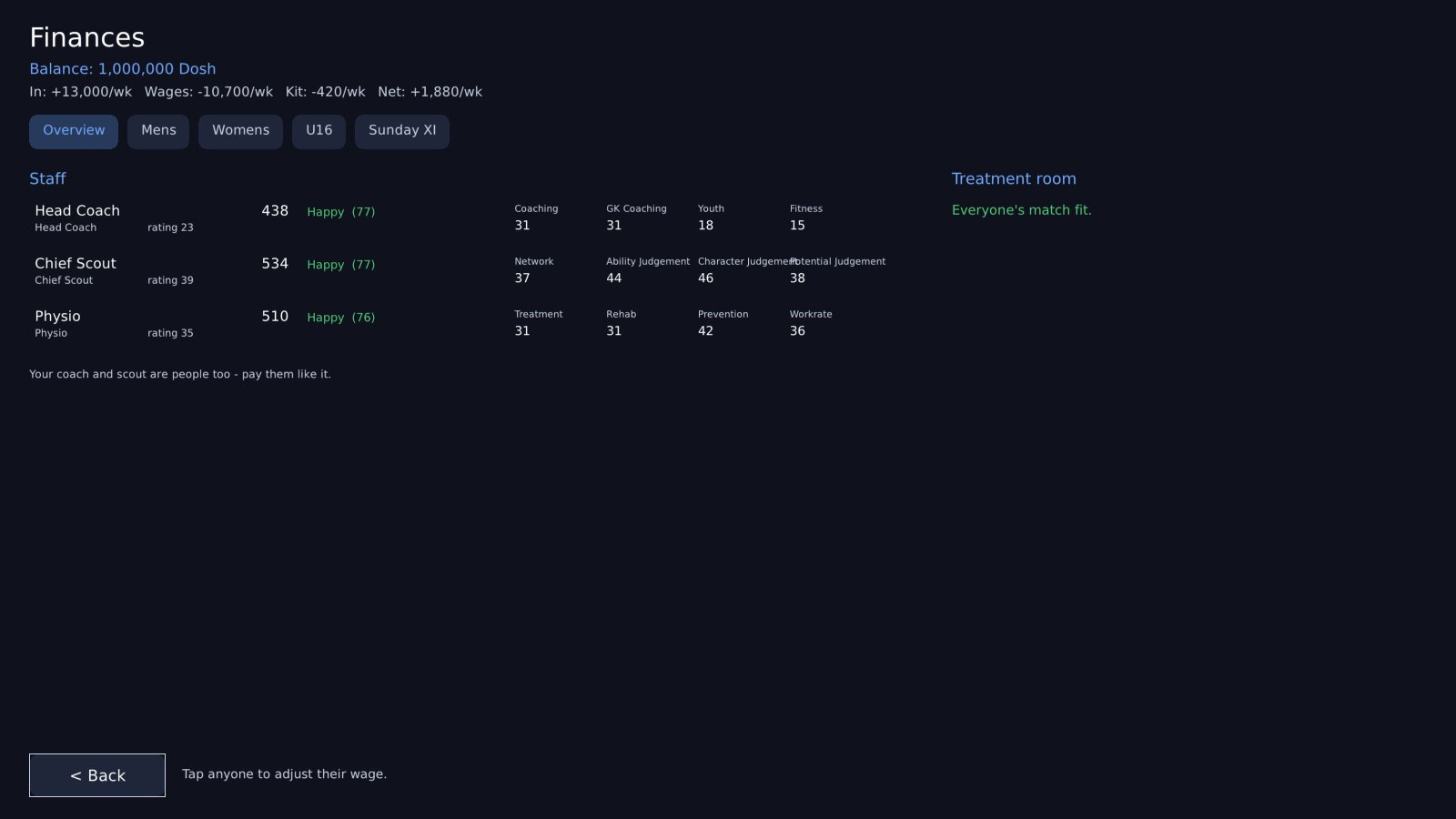
Money is counted in DOSH, written with the club currency mark: a D struck through twice. Every figure in the game - balance, wages, values, transfer fees - is in Dosh, and there is no other kind of money anywhere near this game.
Every club receives the SAME income every matchday - champions and strugglers alike. There is nothing to buy with real money and no way to gain a financial edge. Savings come from running the club well.
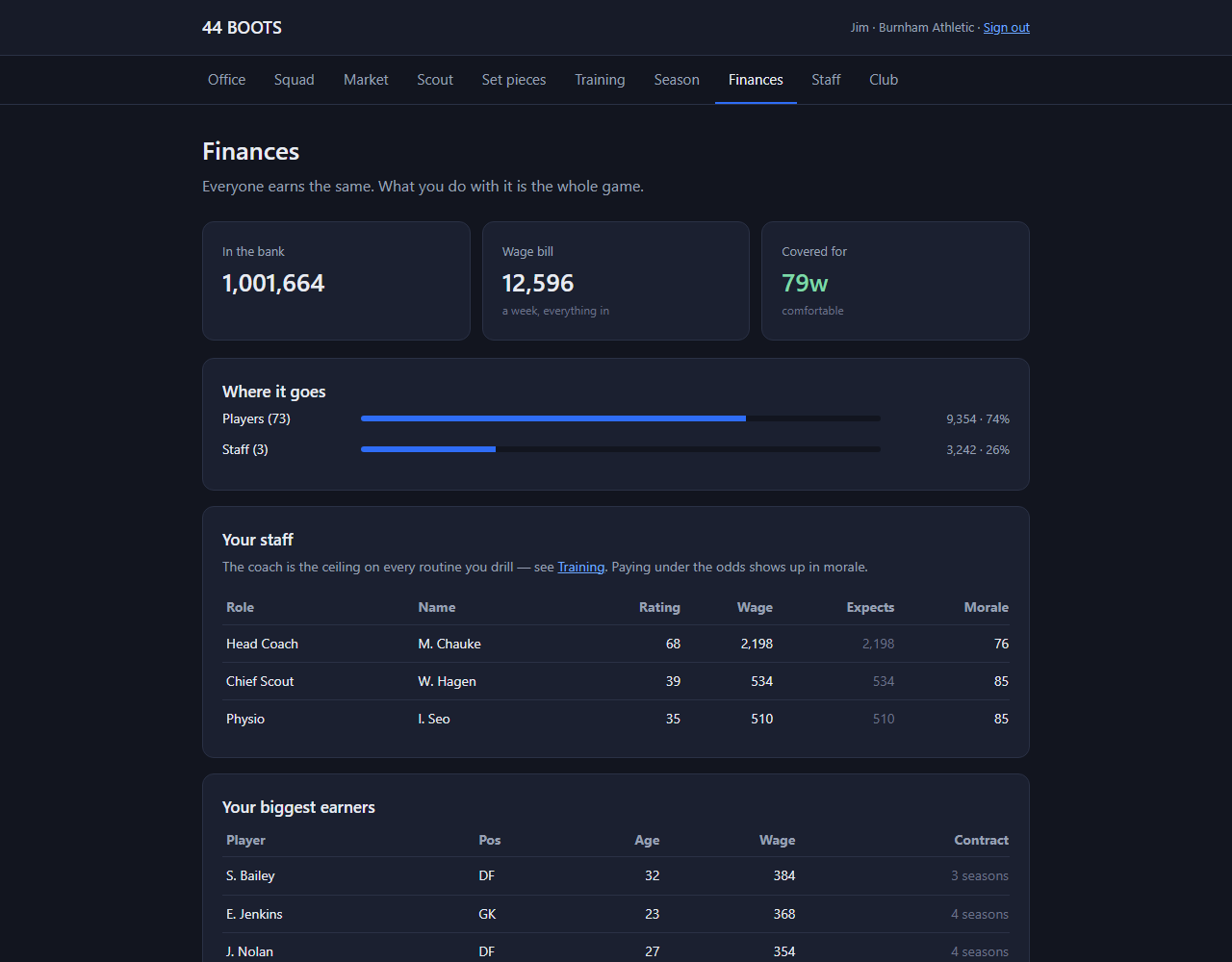
The FINANCES screen is the club's truth: balance, income, wages, kit costs, across the Mens, Womens, U16 and Sunday XI sides plus your staff. Mind the ratchet: a raise lifts what a player believes they's owed forever; a cut banks Dosh at the price of their morale.
At the bottom sits THE BOOK: every pound in and out, line by line, as it happened - matchday income, wages, fees, severance, court fines, John's cut. No mystery money in this game, in either direction.
And the bank CAN run dry. Spend past it and the club goes into the red - and the FA slaps on a TRANSFER EMBARGO: no enquiries, no bids, no new staff until the books balance. You can still sell, and selling is usually the way out. The moment the bank shows black again, the freeze lifts on its own.
The season planner, and the fairness law
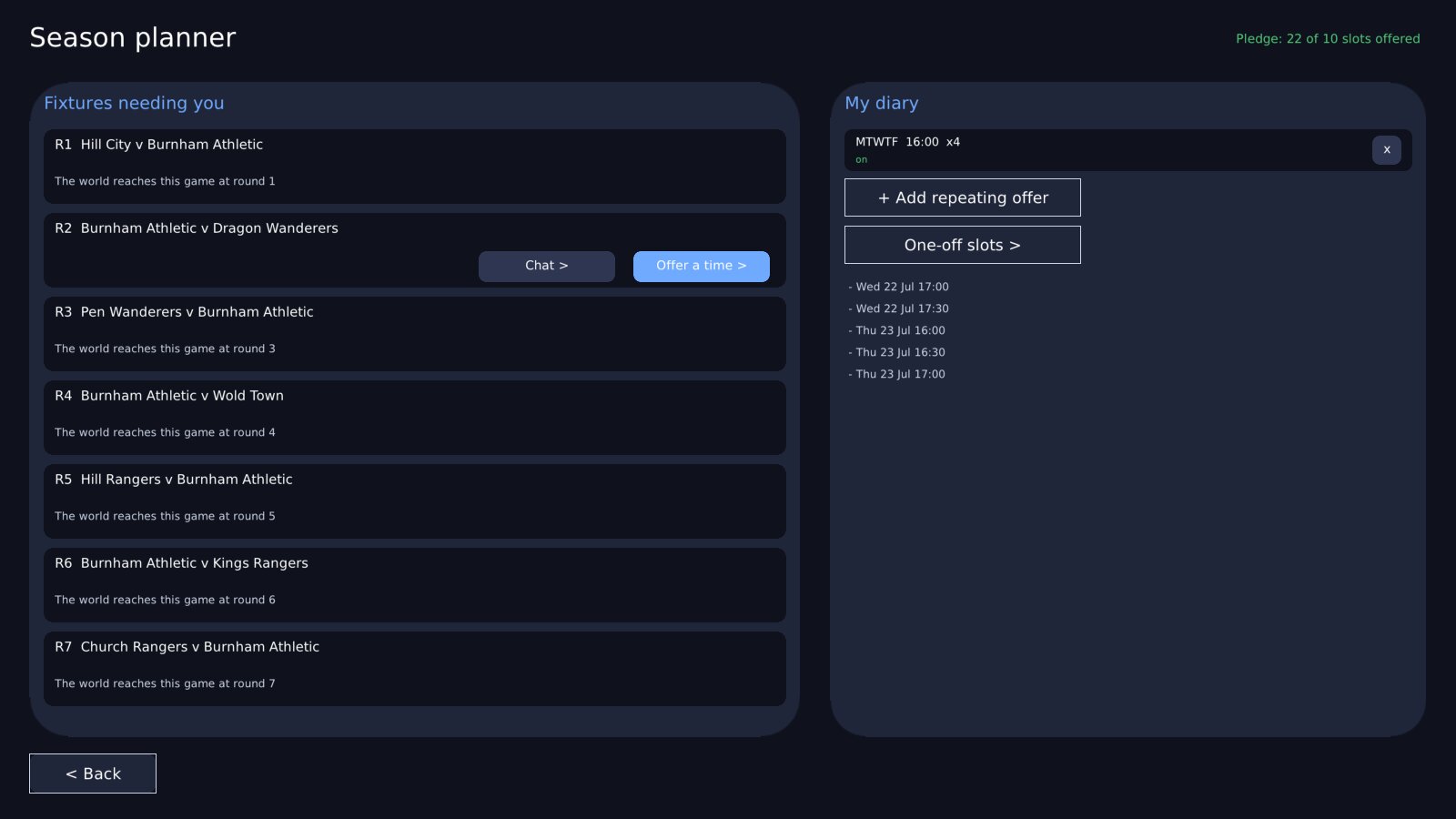
In the PLANNER - in the game or on the website - you set your DIARY: the days and times you can play, in half-hour slots. Click a fixture against a human opponent and you see THEIR open times: take one with a click, or suggest your own. They accept or decline; a booking locks both diaries and the kick-off is SHARP. Bookings go at most a week ahead and cancel free until an hour before - inside the hour, it stands.
THE FAIRNESS LAW: a fixture must be sorted within five league days of its round arriving. FINDABLE means at least three open slots across two DIFFERENT days - one repeated hour does not count, on purpose, so nobody can say "play me at my hour or not at all". At the deadline, a manager nobody could find has their team play WITHOUT them; two findable managers whose diaries simply never crossed get the overnight formula, no blame attached.
Short of time, or just not fussed this week? LET AI PLAY IT FOR ME sits on every fixture, with a take-back. Turning up is always the stronger play - but the season never waits for anybody.
The player lounge
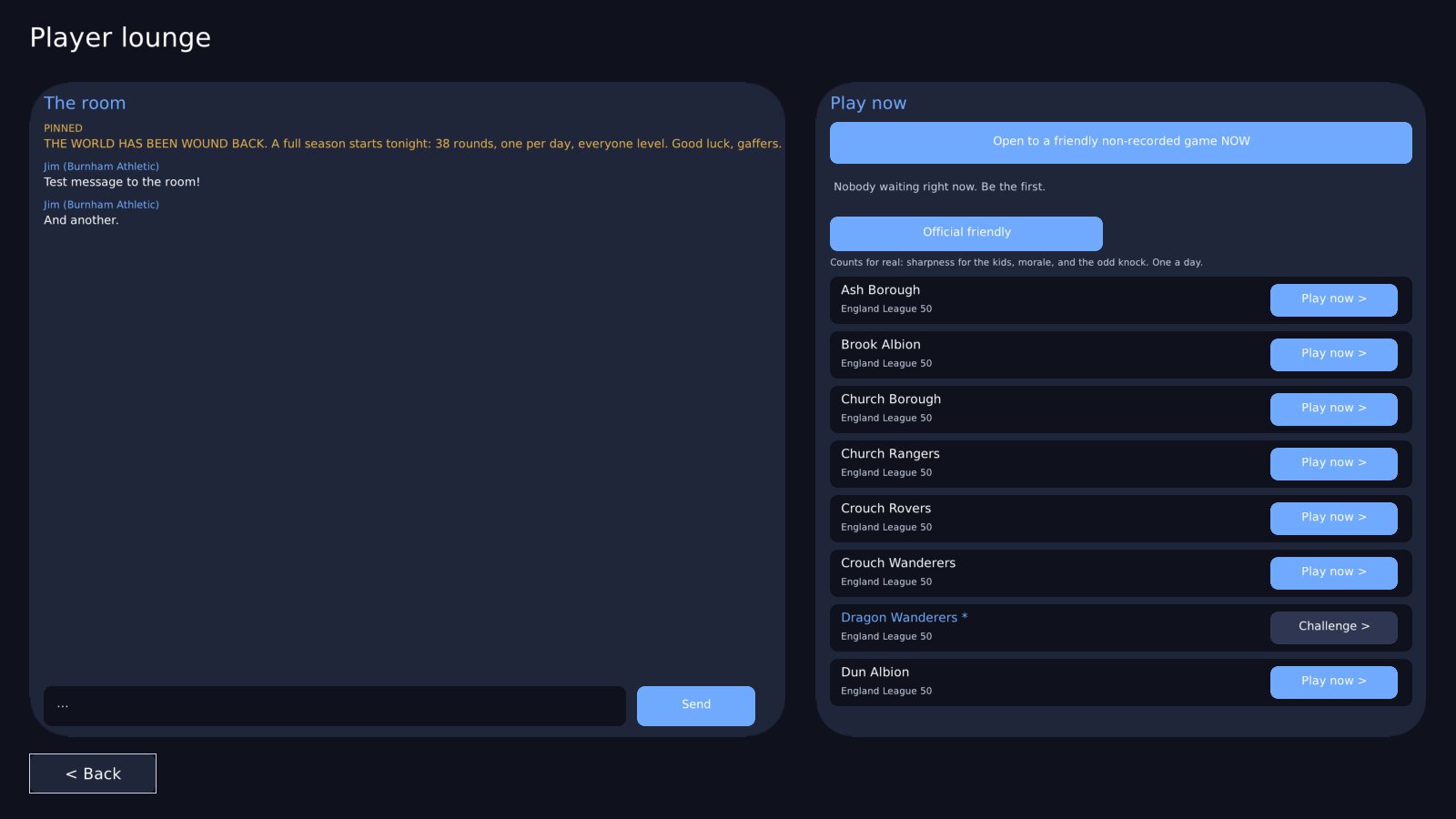
Every manager, one shared board. Posts expire after 12 hours - the room stays current. Pinned notices come from the game itself.
Tap OPEN TO A FRIENDLY NOW to join the waiting list; tap someone else's entry to start a casual game with a 60-second countdown. Official friendlies (one per day) sharpen your under-21s, move morale, and risk the odd knock.
Honest John's transfer market
Signed professionals move through the MARKET, and every deal goes through Honest John, the game's agent - in the app or right on the website, where the whole world is on the shelves: players coming free, superstars, wonderkids, bargains, the unsettled, and a full hunt across every league. ANY professional, ANY division - though a player asked to drop down bends on nothing and gouges on wages. John deals in professionals only: no pub players, no schoolkids, nobody into the wrong dressing room.
Sound a player out - openness, likely fee, likely wage demand - then bid. The fee tracks the contract: long deals cost a premium, final-year players go cheap, and a sounded-out player's head gets turned.
Some contracts carry a RELEASE CLAUSE, and the clause is the clause: bid the number and the selling club has NO say - the fee is agreed by law and you go straight to personal terms. It cuts both ways; write a low clause into your own star's deal and one day somebody will read it.
Want a player gone? PUT THEM UP FOR SALE from the squad page. The FOR SALE sign goes up for the whole world, buyers pay 15% under John's usual ask, and the AI clubs come looking for listed players first. Take the sign down any time, no harm done.
The first team holds 22, and a full squad is a decision rather than a wall: the deal screen lists your players, weakest first, and RELEASING one costs six weeks' wages per season left on their deal. They walk away unattached - someone else's bargain now.
Ask John about a player and you get a READ, not a number: whether the player is settled, underpaid, unhappy or ambitious; what their club would listen to; what they'd want in wages and years; and their verdict. They are called Honest John and they mean it - when a deal is over the odds, or the player simply will not come, they tell you so, even though saying it costs them their own five percent.
Fee agreed, you talk personal terms against their self-worth - and the whole BONUS MENU is on the table: a signing-on fee, money per appearance, per goal, per clean sheet, per win, and a promotion pot. Bonuses count toward what the player thinks the deal is worth, priced by WHO THEY ARE: a gambler who backs themselves counts earnable money nearly as wages and signs cheap; a careful player wants it guaranteed. Every bonus is paid the day it is earned and lands in the book, line by line. John takes five percent of the fee and everyone pretends not to notice.
Or don't buy them - BORROW them. A LOAN costs four weeks of their wages as a fee, then your agreed share of their wage (50-100%) while they are yours; their parent club covers the rest. They take a chair in YOUR squad (22 is the book, loans included) and free one at home - a loan is also how you make room. They go home when the season ends, their parent can RECALL them while a window is open, and they will NEVER play against them - the classic clause, always written in. Young loanees GROW on real minutes: the whole point.
Put your own surplus on the LOAN LIST from the squad page: clubs short of a body come asking, the AI shops the list nightly, and every ask lands on your desk to accept or refuse. A player out on loan cannot be sold, released or listed until they are home.
Offers for YOUR players arrive at the top of the market screen: accept the fee, push back with a counter, or reject it outright. The AI clubs shop as well - they re-sign their own stars and come knocking for yours, so nobody farms them for free.
AI clubs play the same market: they renew their expiring stars mid-season and will come knocking for yours - offers land in your office and are answered in the market screen. Renewals live there too: a new deal always costs a raise, and the ratchet remembers. The window is open for most of the season and SHUT for the final week.
Everything about a signed professional is public - attributes, wage, contract, value. Only your judgement differs. Unsigned talent is another matter, and that is what your Chief Scout is for.
Scouting: the find, the trial, the report
Your Chief Scout spends the season watching football nobody else is watching. A good one turns up six to eight names in a season; a poor one about half that. They knock rarely, and that is the point - this is not a shop window.
Open THE SCOUT'S DESK and you get their opinion in full: every attribute, as a plain number. No ranges, no fog, no guessing game. What varies is how CLOSE those numbers are, and the screen says so in words at the top. An excellent judge lands within a point or two; a poor one can be fifteen out in either direction. Treat them as a steer, not as fact.
Then it is your call. OFFER A TRIAL and the player joins TRAINING - not a team, not the squad list, no wages. A week or two later the Head Coach files their report: the MEASURED attributes, exact, plus how good the player could eventually become. That ceiling is the thing actually worth having. Trialists are raw, and most of them start well below your first team.
Now SIGN or RELEASE. A signing joins the side that fits: sixteen and under go into the academy on no wage, women into the womens first team, everyone else into the first team on a modest three-season contract. The first team still holds 22, so if it is full you must move someone on before you can sign - the same rule as promotion. Turn someone down and they go back into the world, where a rival's scout may well find them next.
Three players at a time can be in training, so a trial is a decision rather than a conveyor belt. And your scout is a person: pay them properly and their eye is worth having - the Finances screen shows their Network and their Ability, Character and Potential Judgement.
Live matches and your connection
YOU MUST ENSURE YOU HAVE A STABLE INTERNET CONNECTION WHEN PLAYING A GAME. Your connection is your responsibility, from kick-off to final whistle.
Human-vs-human matches run DEVICE TO DEVICE: both phones (or PCs) simulate the identical match and stay in perfect sync. No server sits in the middle, which is why it is fast and free - and why your connection matters.
In a match that counts, disconnecting means you LOSE it - and there are NO reschedules, ever. Any rematch rule would let a losing manager fake a drop and cheat their way out of a result, so the rule is blunt on purpose. Casual lounge games carry no such sting - if a link drops, the match simply carries on locally and counts for nothing, as casual games always do.
If BOTH managers drop out of a recorded match, neither result stands: the fixture goes back to the world, and the overnight formula settles it like any unplayed game.
Both players must be on the SAME build of the game to play live - the lounge will refuse to link mismatched versions. If it does, update from the office card or this site and try again.
Your phone will not fall asleep on you during a match, a replay, or while you are sat in the lounge or the planner waiting on a kick-off. Everywhere else it behaves normally and dims as it always would.
Playing a rival LIVE
When your league fixture is against another manager, you don't play their ghost - you play THEM, live, with both devices running the identical match in step. Agree a kick-off time in the planner first; from five minutes before, the fixture offers CONNECT FOR KICK-OFF.
The start is SHARP: connect early and the countdown holds until the agreed second. If your opponent never appears, you get the option to play their side under AI management and the result stands. If NEITHER of you appears, the fixture goes back to the world and is settled overnight by the formula.
Both managers must be on the same build of the game - the lounge and the planner will refuse to link mismatched versions. Update from the card in your office.
The end of a season
When the final round has been played - plus a few days' grace for games in hand - the season closes itself. Anything still unplayed is settled by the world, the table goes final, and the champions are announced in your inbox and in the lounge.
Where the pyramid has a division above or below, the top three go up and the bottom three go down. Champions of the very top division stay kings of the hill - there is nowhere higher to go.
Then contracts tick down a year. AI clubs quietly re-sign their expiring players; a player YOU let run out of contract walks for nothing. Renew them in the market before the season ends, or lose them for free. The new fixture list is drawn overnight and it all begins again.
The pathway
Your U16s develop FAST under a coach with a good youth eye - the academy is the fast lane. A schoolkid's registration ends with school: no academy deal runs past seventeen, and no adult can be signed into a U16 side.
GRADUATION DAY comes with each new season: every kid who has turned seventeen gets their verdict, best first. A chair in the senior dressing room means a shirt and a first pro contract; a full squad means a handshake and the pool - the hardest day in football, and it happens here too.
The Sunday XI hides the odd gem, and your scout is how gems reach the first team. The pub always provides.
THE WOMEN are professionals, and always have been: they train on your training ground under your coach, they use the facilities you have built, they draw wages and their own kit bill, and they play their own league on Mondays, Wednesdays and Saturdays. What is new is that you can TAKE THEM - say so in the office and their squad, their market, their treatment room, their table and their MATCHES become yours. In the app, the My teams panel is a switch: tap the women and the whole game moves to them - their fixtures, their squad, their tactics board, their strip and the match itself, live in 3D.
Cards and suspensions
The referee keeps a book. Yellows and reds are earned by WHO a player is - the dirty and the aggressive collect them - and the squad page shows each player's cards with the count in white inside.
The rules are the real ones, near enough: two yellows in a match is a red and a one-match ban; a straight red is two matches, and the Gazette will enjoy writing it up; every fifth yellow of the season is a match on the sidelines - totting up. Bans tick down as your fixtures pass, the book wipes clean at each new season, and an unserved ban carries over: a red in the last game is served in the first.
A banned player is marked BANNED on the squad page and weakens the side until they are back.
Strips, sound, replays and settings
The STRIP DESIGNER (in Settings) sets your home and away kits. If your opponent's colours clash on match day, the away side changes, as the Laws intend.
The match has a voice: a light touch as a player dribbles, a firmer strike on a pass, a proper thump on a shot - and the crowd when one goes in. There is no music. This is a simulation, not a jukebox.
Every match records itself - REPLAY plays back your most recent game, kept on your device and in the cloud, so you can play on the phone and rewatch on the PC.
The game speaks English, Spanish, German, French, Portuguese, Italian and Dutch. Tap LANGUAGE in Settings to choose one - the screen changes as you tap, and the choice sticks on that device.
Leave it on AUTOMATIC and the game works it out for itself: first the language you signed up in here on 44boots.com, then your device's own language, and English if we don't speak yours yet. Sign up in Dutch and the game arrives in Dutch, whatever your phone is set to.
Your club in a browser
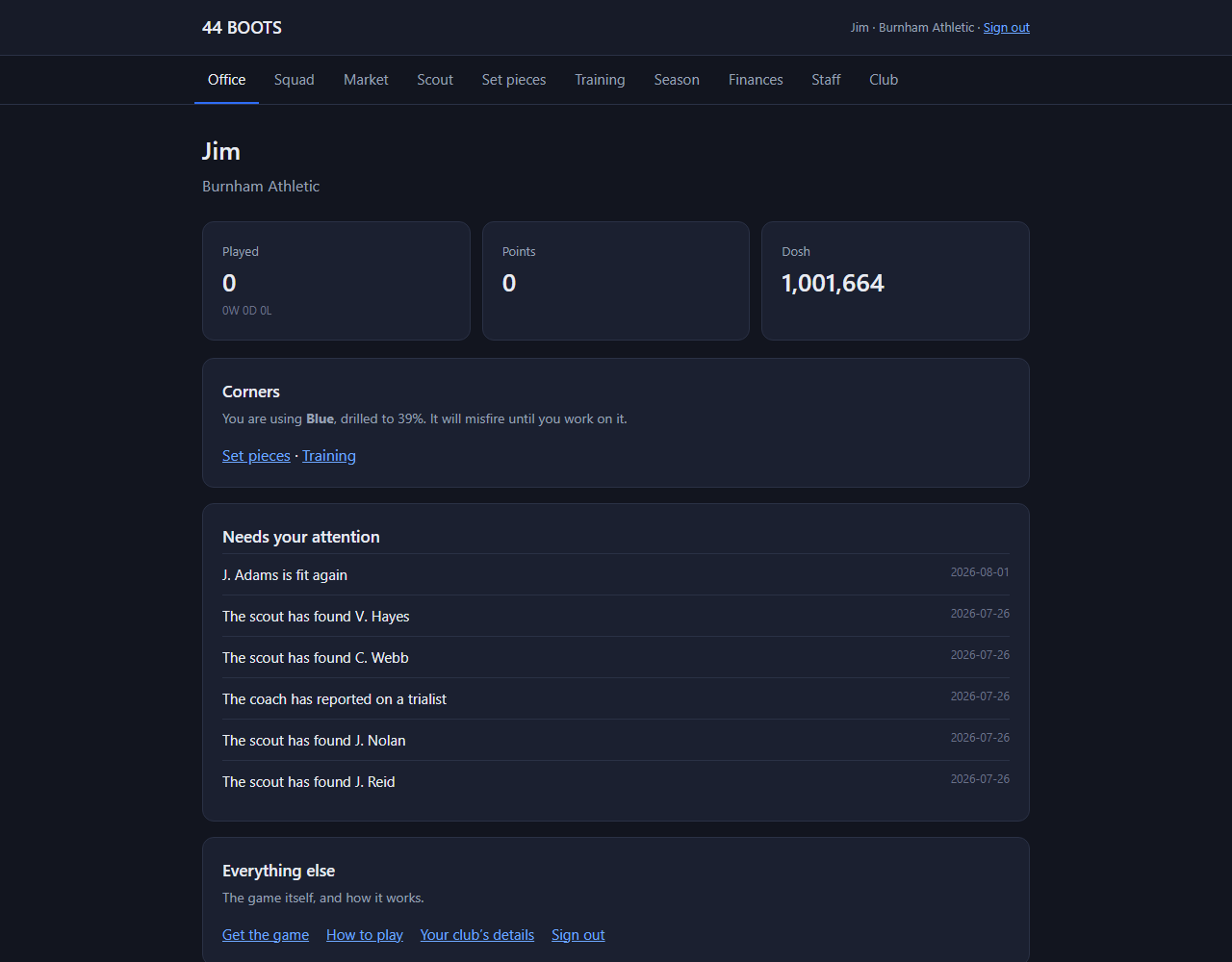
Everything at 44boots.com/manager, behind your normal sign-in: Office, Squad, Physio, Leagues, Forum, Market, Scout, Set pieces, Training, Season, Finances, Staff and Club.
Every club in the league table is a DOOR: click through to any squad and backroom. Every player is a page. The Gazette writes the league's news in the forum - injuries worth printing, scandals, sendings off - and its cuttings file themselves on the players they are about.
It is the same club either way. Chalk a corner on the whiteboard at lunchtime and it is what your side does on Saturday in the game. The screens that matter minutes before kick-off - team setup, the lounge, the match itself - stay in the game, where they work with no signal.
The whiteboard - set pieces
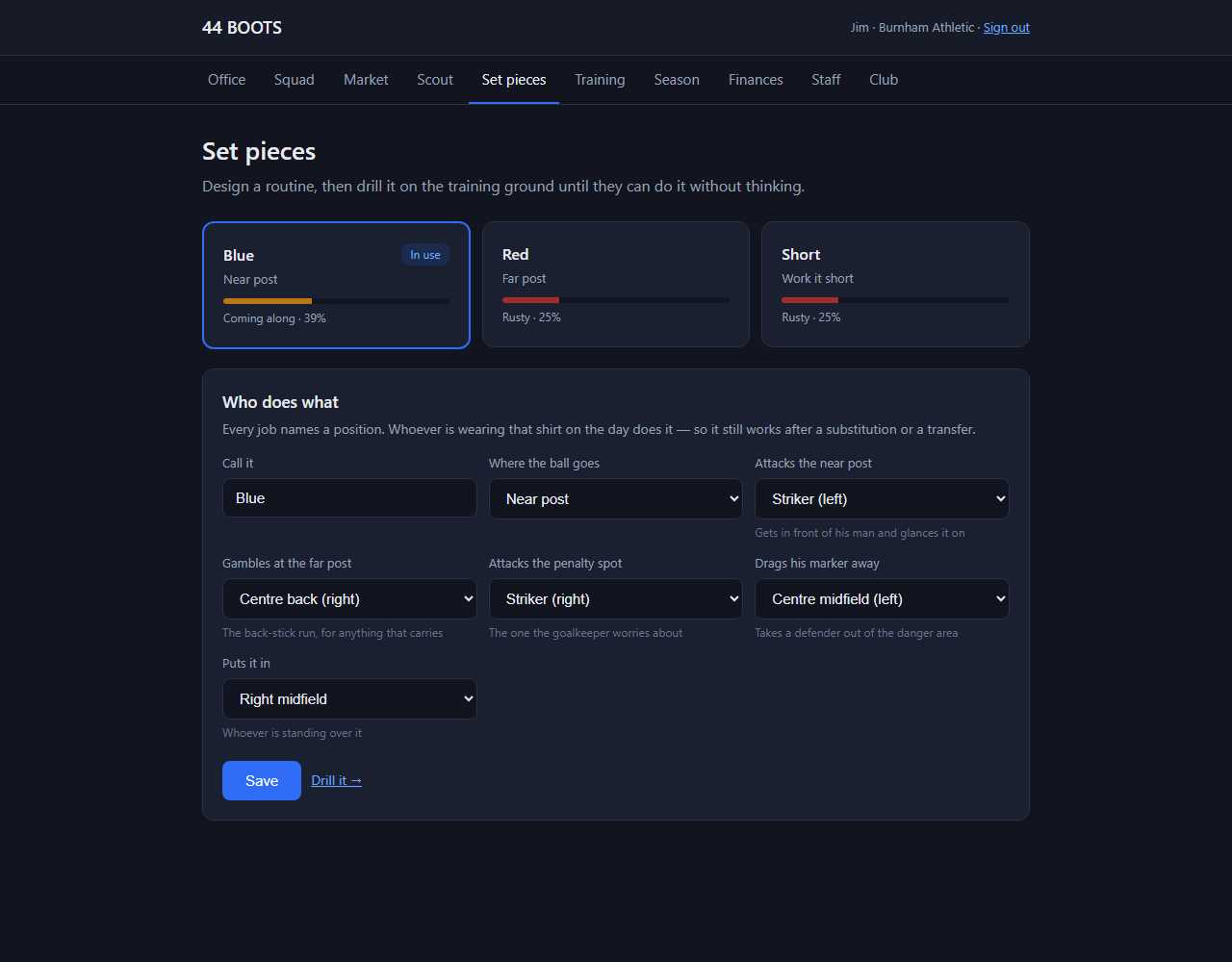
SET PIECES is a magnetic tactics board: a white half-pitch, red magnets you DRAG, a yellow one on the ball. Place each player, drag the hollow ring to draw their run, tap them for their job - near post, far post, the spot, short option, screen, edge, stays back - and tell each magnet WHO they are: number, position or name, your choice.
THE WALL holds twelve shelves: corners left and right (up to ten boards each), wide free kicks, central and direct ones, throw-ins, kick-offs - and the defensive organisations, where the yellow ball is THEIRS and the jobs become the wall, the posts, zonal patches, man-marking and staying up for the counter. Design a left-side routine and MIRROR draws its right-side twin for nothing - though the squad has to learn the mirror too.
Then pick up to TEN boards into THIS WEEK'S PLAN - the ones you are preparing for the opponent you face. The plan is what gets drilled and what the side takes into the match. Every board has a FAMILIARITY that climbs when drilled and rots when ignored, and your coach's quality caps how well anything is ever known.
And the engine ACTIONS your boards - THE WHOLE WALL: corners, free kicks (the right shelf picked by where the kick is), throw-ins (your taker magnet names the thrower - the long thrower at last), kick-off routines and the defensive organisations. Your drawing is the PLAN, never a puppet script: each magnet's spot, run and job go to that player as ORDERS, and the moment the ball is struck the drawn runs break - but every player still reads the game with their own head. A marker can smell the routine; a poor delivery ruins the cleverest drawing; a drilled side takes up its marks crisply, a rusty one nearly. You position the magnets. The players play.
The match archive - replays and films
Every LIVE game a human is part of is saved on the final whistle. MATCHES (in your office on the web, and on the app's bar) lists them all with their scorelines - your last twenty.
Two ways to watch. IN THE GAME: pick any match on the app's Matches screen and the full replay downloads and plays through the real renderers - every run, any camera. IN ANY BROWSER: every match has a share link that plays it instantly, top-down, on any phone or laptop - no account, no app, nothing to install. The browser itself is the projector: it fetches the tiny saved match and draws it live, with jump-to-goal buttons and a SAVE A CLIP button that records a shareable video right on the viewer's device. Copy the share link from the Matches page and post it anywhere.
The book of seasons
Seasons no longer forget themselves: every final table is kept exactly as it finished. LEAGUES links to your division's book - champions and full tables, season by season - and every club's page carries its own history and honours. Titles now accumulate on the record, which is rather the point of winning them.
And the office EMAILS you about things that expire - a bid on your player, a staff war nearly out of clock, a fixture the fairness law is about to settle. Once per event, never spam, one-click unsubscribe in every mail.
The training week
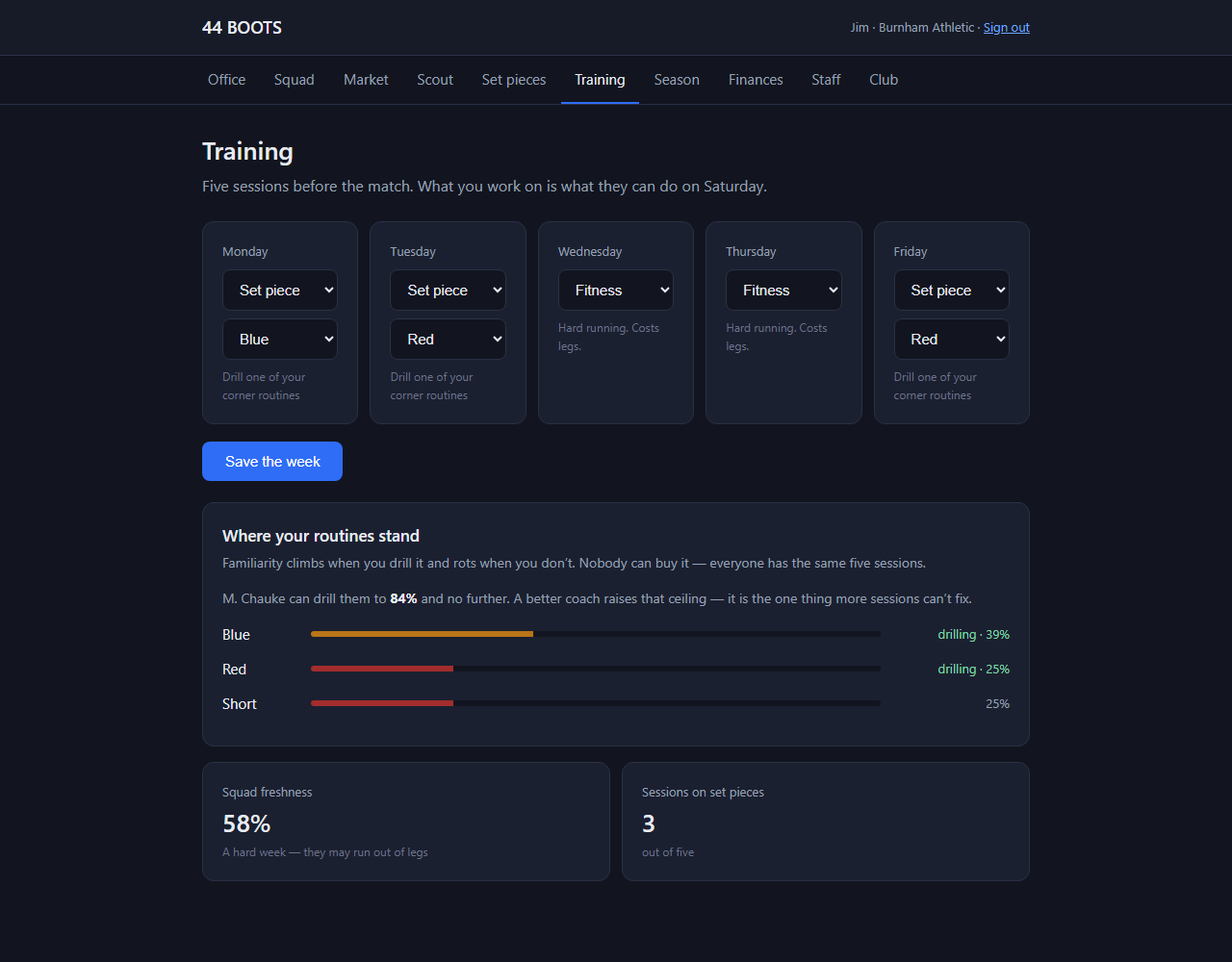
TRAINING is thirty coaching hours: Monday to Friday, three in the morning, lunch, three in the afternoon. Pick a brush - light, fitness, ball work, shape or set pieces - and PAINT the hours; drag to paint a whole morning in one sweep.
The work is real. Fitness hours put points on legs, ball work on touch, shape on the thinking - small gains, capped by each player's potential, on top of natural growth. A set-piece hour works up to FIVE boards you assign to it; leave it unassigned and it walks the plan. Light hours are gentle mixed work that give the legs back. You can only train what you have designed - the wall feeds the week.
Each day's column says how hard you are pushing: light, steady, hard or brutal. FRESHNESS is a ledger with consequences - hard weeks spend it, nights, weekends and light hours buy it back, and a tired squad picks up more training knocks and drags on match day. Sunday is the recovery. That is what it is for.
And freshness now WALKS OUT WITH THEM. What the week left in the legs is what each player starts the match with: a fresh squad kicks off with a full tank, an overtrained one is already spent before a ball is kicked. See "The legs" below.
The legs - fatigue in the match
Every player has a tank, and ninety minutes empties it. SPRINTING costs far more than jogging - a player who chases everything is one who has nothing left at the end - and the goalkeeper, who walks most of it, barely dips.
STAMINA decides the rate. A player with it is still going in the last ten minutes; a player without it is blowing by the hour, whatever else they can do. It is one of the quietest attributes on the page and one of the most valuable.
THE WEATHER TAKES ITS SHARE. A scorcher costs about a third more than an ordinary afternoon; heavy snow and a storm are hard work too; a warm day or a freezing night take a little. That is the same sky the whole league is playing under, and it is shown in the corner of the scoreboard.
WHAT TIRED LEGS DO. The first yard goes before the top speed does - a spent defender arrives a moment late, which is a moment too late. The touch gets heavier, so passes and shots stray more. And a duel goes to whoever has more left: that is why the last twenty minutes decide so many matches, and why a fresh substitute can walk through a tired midfield.
WHAT YOU DO ABOUT IT. Half time gives a little back, and that is all the rest anybody gets. The SUBSTITUTIONS screen in the app shows every player's tank as a percentage - green is fine, amber is thinking about it, red is done - so the change you make is an informed one rather than a hunch. Five substitutions, three windows: spend them on legs, not just on names.
YOUR ORDERS COST LEGS TOO. Pressing high, playing at a fast tempo, going gung-ho and getting stuck in all empty the tank quicker - press for twenty minutes and you have spent your last ten. Containing, sitting deep and killing the game give a little back. A shout is not a switch; it is something you spend.
AND THE OTHER MANAGER KNOWS ALL THIS. An AI side has a bench and uses it, from the hour onwards, taking off whoever has least left in them - so fatigue is not a punishment only the attentive human pays. On a scorcher they will empty the bench.
The season, and the squad
A match does not end when the whistle goes: it goes on your players' legs. Every player carries a CONDITION - shown in words on the SQUAD page, with a "legs gone" count in the summary strip - and ninety minutes takes a real bite out of it. A player without stamina pays more; one past thirty pays more again; a substitute who played twenty minutes barely notices. That is the honest reason to own a squad rather than an XI.
IT COMES BACK WITH REST. Every day gives some of it back, and the estate decides how much: ice baths, a cryo chamber and a hydrotherapy suite all speed it, and a conditioning coach speeds it further. This is where the money you spent in the Boardroom shows up between matches rather than during them.
AND TIRED LEGS SNAP. The weekly knock roll reads the squad's condition as well as the training week, and the player who picks up the injury is more likely to be the one who has least left. Playing the same eleven every week is how you lose three of them at once.
ROTATE, THEN. The office will tell you when players are running on empty, when the squad is overtrained, and when there is weather coming. STAMINA is now a column and a sort on the transfer market for exactly this reason - the quiet attribute that decides who is still running at the end.
Your backroom staff
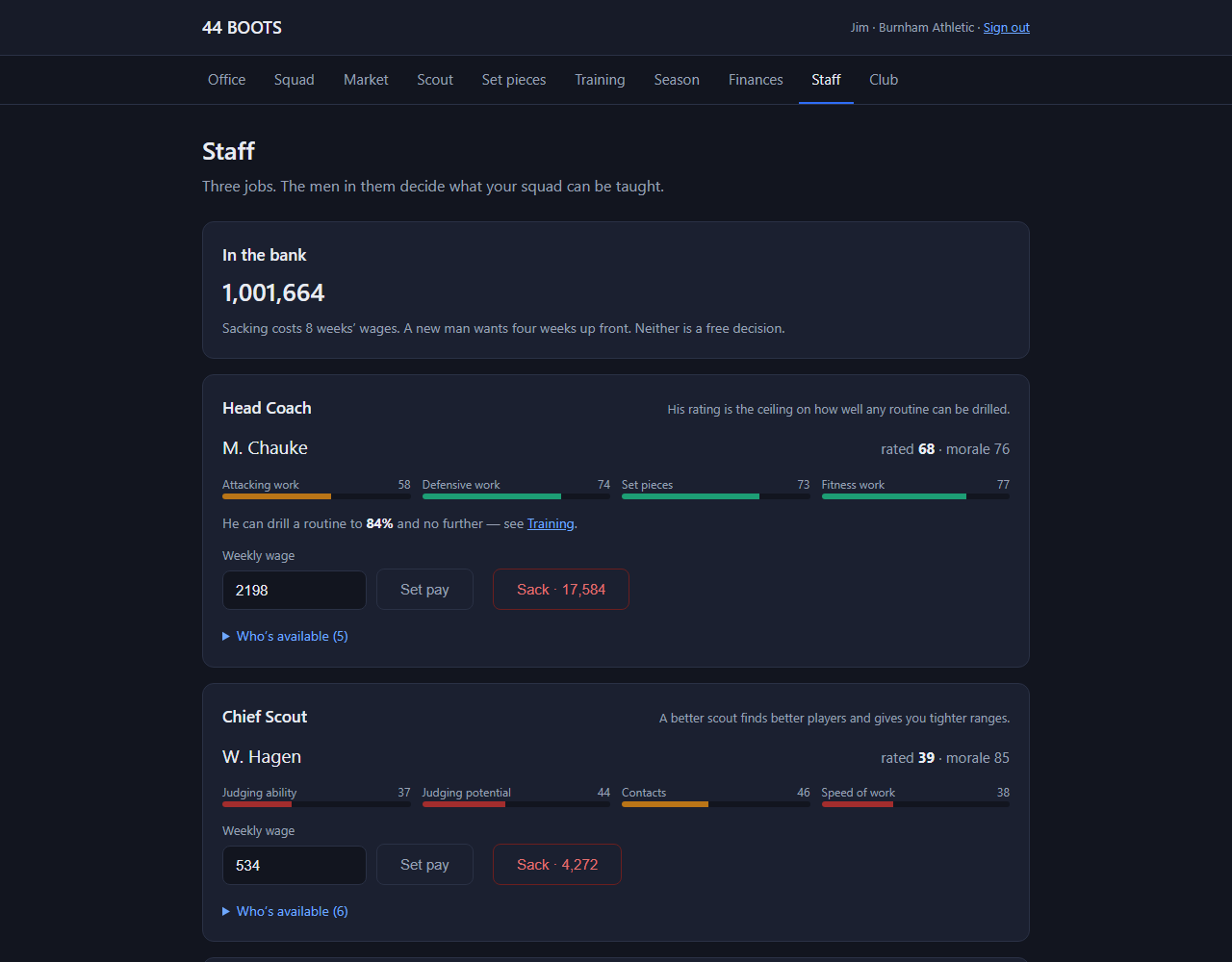
Three jobs every club needs: COACH, SCOUT, PHYSIO. Pay them more, pay them less, sack them, or add to them from the STAFF page.
THE COACHING IS A CEILING. However often you drill a routine, it only ever gets as sharp as the coaching teaching it - a journeyman tops out around two thirds, a proper coach takes you past ninety. More sessions cannot fix poor coaching; only better coaching can. Better scouting, meanwhile, does not just find better players, it gives you a TIGHTER answer about them.
MORE THAN ONE IN A JOB. You can carry up to five coaches, five scouts, five physios. Their wages add up in full; their benefit does not. The best of them counts in full, the next for about HALF of what they would add on their own, the next for half of that, and so on - two 60-rated coaches work like a 90, three like a 100 on three wages. Then there is CHEMISTRY, which is luck: every player you sign rolls a hidden number for how they fit, and it scales their share. Two coaches who click lose a lot less than half; two who clash lose a lot more. The staff page tells you after a couple of rounds ("they click", "a bit of friction", "they clash") and the market table shows honestly what one more would ADD. The specialists are the exception: each keeps their own diary, so a second psychologist is simply three more slots.
EVERYONE IS ON A CONTRACT of one to three seasons, chosen when they sign - longer costs a little more a week, because they are selling you certainty. Contracts tick down at the end of every season. When a player reaches the end, they re-sign for a year if you have been paying them what they think they are worth, and WALKS if you have not. A player in their FINAL season is the one the AI clubs ring.
Sacking somebody pays off what is left of their deal - never less than eight weeks' wages, never more than a season - and a new hire wants four weeks up front. Neither is free, and since every club earns the same money, a brilliant backroom is paid for out of the same pot as your players. A thin squad with a great coach is a real strategy, and so is the reverse.
Beyond the three essentials sits the OPTIONAL BACKROOM: a TEAM PSYCHOLOGIST, a GOALKEEPING COACH, a CONDITIONING COACH and a PERFORMANCE ANALYST. Nobody needs them - that is the point. The first three keep a small DIARY: you assign named players (three to the shrink, two keepers to the gloves, three to the conditioner), and the work happens quietly each week alongside training. The psychologist moves the one thing training never touches - the HEAD: temperament and off-field discipline up, aggression and dirtiness down, so the player who keeps getting booked slowly stops. Slowly is the word: people change a little, young players more than old, and a butcher becomes a butcher who gets booked less, never a saint.
The gloves coach fast-lanes their two keepers' goalkeeping. The conditioner's clients dodge some training knocks and age more gently. The analyst takes no clients - they film EVERYTHING, so your whiteboard routines drill faster, fade slower, and carry a shade more onto the pitch. All four are ordinary staff underneath: hired from the market, poachable by telephone, and paid out of the one pot.
WHO'S AVAILABLE now actually is: the market restocks itself, per division, scaled to how many managers play - and the odd unsold face moves on, so the candidates change. Poaching a rival's staff is no longer the only way to fill a chair.
And staff have TELEPHONES. Players move in windows; a coach, scout or physio can be approached ALL YEAR - yours included. Visit any club's page, make an approach, and be ready for a bidding war: their club can counter, and every staff member has a LOYALTY - shown in words on the market and the staff page, from "one of ours" to "suitcase by the door". Most are somewhere in the middle; the suitcase sort is rare, and cheaper for it. A one-club sort turns down anything short of silly money. Loyalty grows a little with every season served and paid properly, and shrinks with every season underpaid.
Poaching somebody under CONTRACT costs COMPENSATION on top of their signing money: the wages left on their deal, capped at one season, paid to the club they are leaving. So a player on a fresh three-year deal is expensive to prise away and their club is paid for the trouble; a player in their final weeks is cheap. The AI clubs know this - they only ring staff in their FINAL season, and only the unsettled ones: unhappy, or clearly underpaid. A happy, loyal player on a long deal is left alone. When a rival rings YOUR staff, the office tells you: match the money and they stay - knowing their worth now, on a fresh two-year deal - or wave them off, bank the wages and take the compensation.
The Boardroom - money, the estate and the sky
THE BOARDROOM is where the money is: what is in the bank, what this week costs and where it goes, and the ledger of every pound in and out. Every club earns the same; what you build with it is the difference.
BIG-TICKET KIT. Real clubs buy hydrotherapy pools, cryotherapy chambers, anti-gravity treadmills, GPS vests, video suites, gyms, altitude rooms, medical scanners - and so can you. Each is a ONE-OFF price out of the one pot, then a WEEKLY UPKEEP that rides with the wages. Each does one honest thing: a hydro suite heals injuries faster, force plates and GPS mean fewer training knocks, a gym makes the hours count for more and slows the fall of older legs, an anti-gravity treadmill keeps an injured player's legs while they mend, a scanner finds the small tear before it is a big one, a video suite sharpens the analyst.
EVERYTHING WEARS. Kit has a CONDITION that drops every season and a LIFE in seasons. As the condition falls the benefit shrinks; under 25% it may BREAK, and a broken thing gives nothing until you pay to repair it (a slice of its price, back to 90%). Past its life it is WORN OUT: half strength, past repair - replace it or live with it. Most kit can be SOLD for 40% of its price times its condition. The Boardroom shows all of it in bars and words.
THE TRAINING GROUND is a ladder: council pitches (where everyone starts), your OWN GROUND, FLOODLIT ALL-WEATHER pitches, HEATED PITCHES AND AN INDOOR DOME, and at the extreme end a ROOFED PERFORMANCE ARENA. Each tier is built on the last, none of it can be sold - it is land - and the top of the tree is the sort of place players ask to join. Higher tiers make training count for more, keep the squad happier, and mean the weather stops mattering.
THE WEATHER IS REAL and it is your country's. Every league gets one sky a day from its climate for the month - England is wet and grey with the odd scorcher and a little snow; Vanuatu is hot with a stormy wet season - and every fixture that day is played under it. On council pitches RAIN slows training and turns ankles, a STORM or SNOW washes the day out altogether, a SCORCHER cooks the legs, FOG spoils set-piece work. All-weather pitches beat rain and storms; a dome beats everything. The office tells you when a day is lost. Kick-off times carry the hour, and the day, dusk or night of it, into the match.
AND IT FOLLOWS YOU ONTO THE PITCH. The same sky is played under by both managers in a head-to-head, and you can see it in the corner of the scoreboard. RAIN and a STORM let the ball skid on, make passes and shots stray, and turn a won tackle into a loose ball more often than a clean one. SNOW drags the ball and spoils everything. FOG makes the long ball a rumour - keep it short. A SCORCHER gives you a quick, dry surface and legs that empty a third faster. An evening kick-off is played under the floodlights.
THE FORECAST is on the SEASON page, five days of it, against every fixture you have to arrange - so booking a match and picking a side for it are decisions about the weather too. And the sky does not read the league table: bad weather squeezes the good side and the bad one together, so a blizzard round produces upsets nobody could have priced. The Gazette writes those up.
The AI clubs build too, when their bank is comfortable, and every club's page shows what they own. A rich rival with a hydro pool is a rival whose injured players come back a week early.
How players get better - and older
A player improves towards a peak in their mid-twenties, holds that level for a few years, then falls away - and the fall speeds up the further past it they go.
What fades is PHYSICAL: pace, acceleration, stamina. What they can DO with a ball barely moves, because a first touch is a habit and not a muscle. What they KNOW keeps improving into their thirties. That is why a goalkeeper lasts and a winger does not - the keeper's game rests on reflexes and reading the play, and those mostly stay.
Nobody's peak is the same. It is rolled once, for life, and a body that ages well peaks later. Living properly and being well coached stretch the good years, but not for ever.
Potential is what a scout RECKONS, not a wall. A well-coached player can quietly go past it.
Where the adverts come from
The boards round the pitch carry real advertising, and where you told us your club is based decides which ones you see - an Essex manager gets Essex firms.
That is the whole of it. No advert, sponsor or hoarding touches anything the match engine reads. Nobody's team gets better because somebody bought a board, and nobody can buy an advantage here at any price. The advertising is what keeps the game free forever.
The clock, and added time
The scoreboard reads like a real one: 00:00 to 45:00, then 45:00 to 90:00, and past those while the referee's added minutes are played. How long a half actually TAKES is up to you - Settings offers 1 to 10 minutes - but the clock always speaks football.
And it never stops. Not for a throw-in, not for a goal kick, not while they are celebrating. A real clock does not, and one that does is the quickest way to be reminded you are watching a simulation. The referee lets it run and keeps their own book instead: a few seconds for a foul, most of a minute for an injury or a substitution, longer for a goal. At the end of each half the board goes up.
It is their judgement, not a stopwatch. Two identical halves get different boards, a busy game can bring six or seven minutes, and a quiet one can get none at all.
Knocks, the magic sponge and the stretcher
Football hurts. A bad tackle can injure the player on the end of it - genuinely rare, roughly one knock somewhere every few matches, so when it happens it means something. They go down where they were fouled and stay down, and two physios in white coats run on from the dugout, bucket and magic sponge with them, while the free kick waits.
Most knocks are twenty seconds of the sponge: up they get and play on - but HOBBLED, noticeably slower for the rest of the match. A hobbled winger is a decision: the bench is right there.
The bad ones are the stretcher. Strapped in and carried off between the two of them, their match over, your side a player short until you use a substitution - exactly as it would cost you at the real thing.
After the whistle the club doctor grades it, and the office post tells you how long they are out. Remember the calendar: a "week" of recovery passes every real day.
None of it is for show only in one direction - your opponents pick up knocks on the same dice. Practice matches are the exception while we are in beta: the knock rate there is cranked right up so you can see the theatre without waiting weeks for it.
The maintenance window
Every week the game closes for up to two hours, 10:00-12:00 UTC on Wednesdays, so we can work on it without surprising anybody. Most weeks it is over in minutes. No fixture can ever be booked inside that window, so you cannot lose a match to it. This website stays up throughout and tells you when we are back.
Very occasionally a bigger job - moving to a new server, say - needs longer. When it does, a one-off window is announced on the front page at least a week ahead, and the same rule applies: nothing can be booked into it, nothing is missed.
Your club, everywhere
Sign in once and stay signed in. Play on your phone or on the Windows PC build - same club, same matches, kept on your account. The PC comes as a proper installer or a plain zip, whichever you prefer.
When a new build is out, an UPDATE card appears in your office. On Windows the game now fetches and installs it ITSELF: tap the card, watch it download, tap again to restart into the new build. Nothing goes near your browser, so there is no security warning to argue with. It checks what arrived before it touches your install, and if anything is wrong it leaves your working copy exactly as it was.
Forgotten your password? Tap FORGOTTEN YOUR PASSWORD? on the sign-in screen, or go to 44boots.com/reset, and we email you a link to set a new one. The link works once and lasts an hour. Nobody here can look your old password up and read it back to you - passwords are stored scrambled, so setting a new one is the only way in. Doing so signs you out on your other devices; sign back in there with the new one.